Quail Hunting: Bobwhites, Western Quail and Plantations
Where2Hunt staff · Updated Oct 29, 2026
A quail hunting guide covering bobwhite and western quail, wild birds vs plantation hunts, pointing dogs, covey rises, safe gun handling and hunt etiquette.
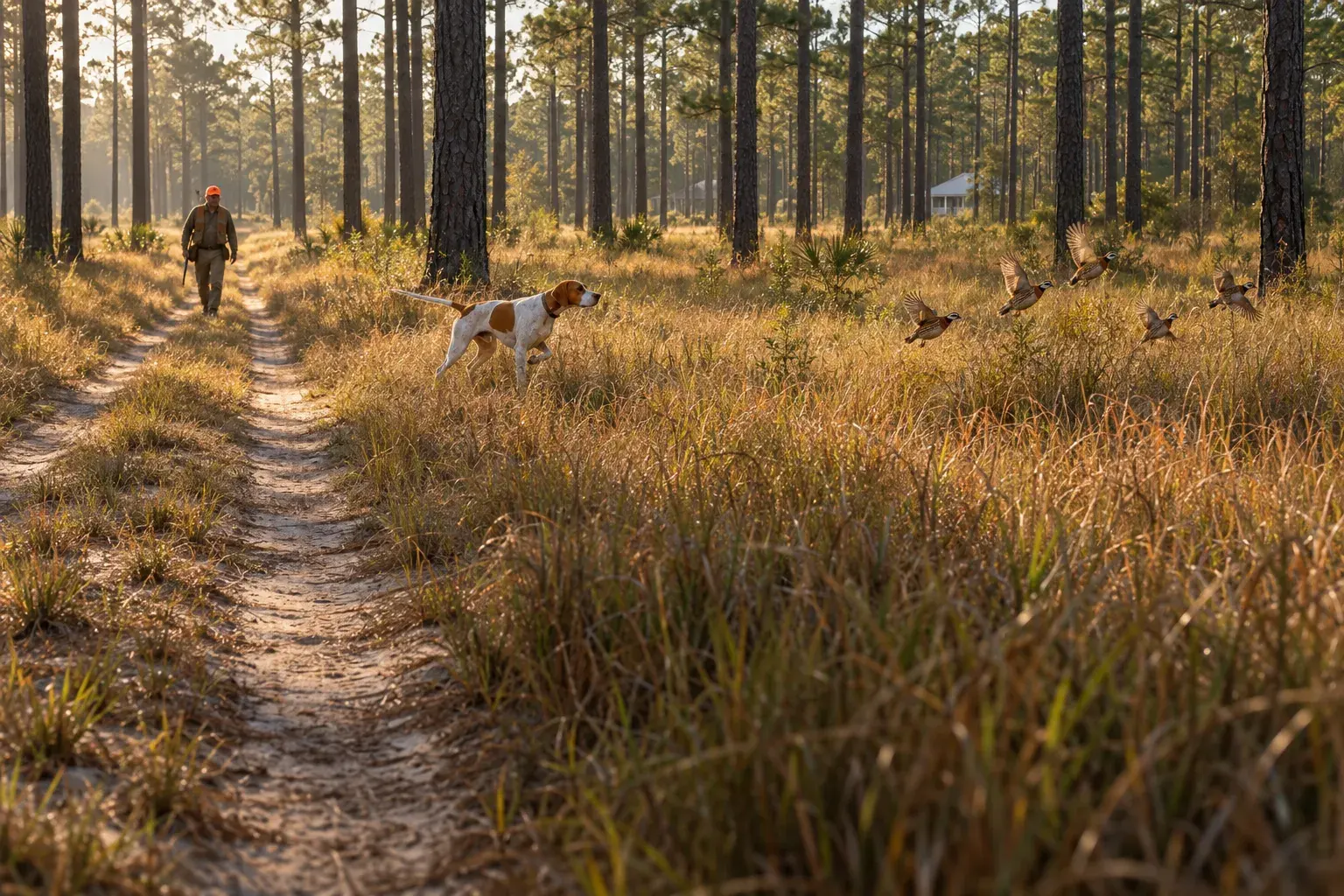
Quail hunting usually means following pointing dogs through grassy, brushy cover until they lock up on a covey, then walking in for the flush and picking out single birds as the covey explodes. In the East and South the bird is the bobwhite, hunted both wild and on plantations and preserves. In the West, hunters chase several desert and mountain species that run more and hold less. Good habitat, good dogs and disciplined gun handling are the core of every quail hunt.
Bobwhite and western quail species
The northern bobwhite is the classic quail of the eastern and central United States. Coveys hold tight for pointing dogs, flush together in a burst and scatter into nearby cover. The bobwhite's familiar whistle is the sound of southern farm country.
The western quail include several species, each tied to its own habitat:
- Gambel's quail in desert scrub and washes of the Southwest
- Scaled quail (often called blue quail) in arid grasslands and brush
- California quail in brushy foothills and valleys of the West Coast and interior West
- Mountain quail in steep, brushy mountain country
- Mearns' quail (Montezuma quail) in oak and grassland hills along the southern border
Western birds often run ahead of dogs and hunters rather than holding, and coveys can flush wild at long distances. Hunting them takes a lot of walking and patience. Mearns' quail are the exception and tend to hold very tightly.
Seasons, limits and legal species vary by state and sometimes by region, so check current rules through our state hunting regulations and agencies directory and our quail species page.
Quail habitat
Quail live where several kinds of cover come together in a small area: bare ground and weeds for feeding, grasses for nesting, and shrubby thickets for escape and loafing. Bobwhites thrive in early successional habitat, the patchy mix of native grasses, broadleaf weeds and brush that follows disturbance.
Wild bobwhite numbers have declined across much of their range as that kind of habitat has been lost to clean farming, closed-canopy forests and fescue pastures. Where land is managed for quail, practices such as prescribed fire in open pine woods, disking strips, field borders and native grass plantings help. Prescribed fire should always be done with trained professionals and the required permits.
When hunting wild birds, look for:
- Field edges where crops meet brush or weedy fencerows
- Plum thickets, briar patches and shrubby draws near food
- Open pine and oak woods with a grassy understory
- In the West, washes, brushy canyons and areas near water
Wild quail hunts vs plantation hunts
Wild bird hunts
Wild quail hunting is often hard work. You may walk many miles to find a few coveys, and a good day is measured by covey finds as much as birds in the bag. Many hunters follow the conservative practice of taking only a few birds from each covey and leaving the rest to survive the winter. Public land, walk-in programs and private ground with permission are all options. Start with public hunting land by state.
Plantation and preserve hunts
Quail plantations, especially in the traditional southern pine country, offer a classic style of hunting on land managed for birds. A typical hunt might include a guide, a dog handler, several pointing dogs working in rotation, a flushing dog for the covey rise and retrieves, and transportation by mule-drawn wagon, horse, truck or ATV between points. Many plantations supplement wild birds with released birds, and some are licensed as preserves with longer seasons.
Browse hunting preserves and ranches and guided hunts and outfitters on Where2Hunt to compare options, and read our post on what a hunting preserve is to understand how licensed preserves work.
Pointing dogs and the covey rise
Most quail hunting is done over pointing dogs such as English pointers, English setters and German shorthaired pointers. The dog ranges ahead, catches scent and freezes on point. Other dogs honor, or back, that point. Then the hunters walk in.
When you approach a point:
- Walk in briskly and with purpose, staying on either side of the dog as the guide directs.
- Expect the unexpected. Birds may flush right under your feet, behind you or to the side.
- Pick one bird. The most common mistake on a covey rise is flock shooting, firing into the whole group and hitting nothing. Focus on a single bird and stay on it.
- Watch for singles. After the covey scatters, note where birds landed. Singles often hold well for a second point.
After shooting, mark where birds fell and let the dogs find them. A good retriever or flushing dog saves a lot of lost birds.
Safe gun handling in a line
Quail hunts put several people, multiple dogs, horses and sometimes wagons close together, with birds flushing in all directions. Safety rules must be clear and followed every time.
- Treat every gun as loaded, and keep the muzzle pointed in a safe direction.
- Load only when walking in on a point, as the guide directs, and unload as soon as the flush is over.
- Guns stay unloaded on wagons, horses and vehicles, and when crossing fences or ditches.
- Shoot only in your zone. Never swing your gun across another hunter, the guide or a horse or wagon.
- No low birds. Never shoot at a bird below the horizon or near the ground, where dogs and people may be.
- Wear blaze orange where required, and wear it anyway when hunting with others in thick cover.
- Wear eye and ear protection.
Plantation hunt etiquette
A plantation hunt is a traditional experience, and following the customs makes it go well for everyone.
- Listen to the guide. The guide decides where you stand, when to load and who shoots. Follow instructions without argument.
- Respect the dogs. Let the handler work them. Do not call or command someone else's dog.
- Shoot your own birds. Take birds on your side, and do not reach across to shoot your partner's bird.
- Be ready on time, with your license, ammunition and gear in order.
- Tipping is customary. Many guests tip their guide, dog handler and sometimes the wagon driver and kitchen staff. Ask the lodge what is customary when you book.
Frequently asked questions
What is the difference between wild quail and plantation quail hunting?
Wild quail hunting means finding naturally occurring coveys, usually with a lot of walking and fewer birds. Plantation hunts take place on land managed for quail, often with guides, dog handlers and released birds that provide more consistent action.
What is the best dog for quail hunting?
Pointing breeds such as English pointers, English setters and German shorthaired pointers are most common, because quail tend to hold for a point. Many plantation hunts also use a flushing dog to put the covey up and retrieve.
What gauge is best for quail hunting?
Many hunters use a 20 or 28 gauge with an open choke such as improved cylinder, since most shots are fairly close. A 12 gauge works too. Check whether nontoxic shot is required where you hunt.
Should you tip on a quail plantation hunt?
Tipping guides and dog handlers is customary on most plantation and guided hunts. Ask the lodge or outfitter what is typical when you book.
General information, not legal advice. Hunting laws vary by state and change every year; confirm with the state wildlife agency. See an error? Tell us.